|
This is one of a series of pages which cover the special
photographers' day on 30th May ahead of the main event over the
weekend..
Click here for
the overall index for the event.
|
|
|
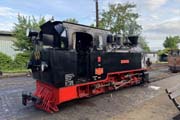
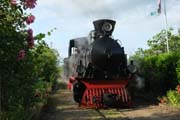
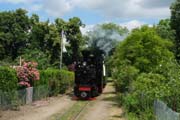
0-8-0T "Merapi" (Hanomag 10409/1925)
One of ten identical locomotives which were delivered to the Oei Tiong Ham factories in Semerang, Java, Indonesia, starting in 1923. They used the locomotives on their numerous sugar cane plantations, including three at Rejoagung.
Locomotive 10409 became number 13 there and was named “Lawoe” until the sugar cane railway was discontinued in 1983/1984. It was decommissioned and acquired by member Peter Neesen, a member of the Dampf-Kleinbahn Mühlenstroth in 1988 and brought back to Germany. There, it was converted from 700 to 600 mm gauge and was to find its new home with the DKBM, who, confusingly, numbered it 10 and renamed “Merapi” (Indonesian for "Fire Mountain"), previously carried by its sister Rejoagung no 10 in 1992, after a volcano on Java to commemorate its former location. It has been in use at the Berlin Park Railway since the end of 1992.
|

|
|
|
|
|
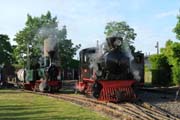
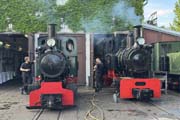
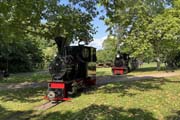
The Budich is on the right here, the other locomotive is resident 5.
|
|
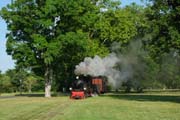
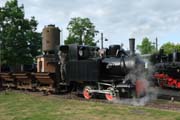
0-4-0T (Budich 1029/1944) visiting from the Fortuna Field and Mine Railway Museum, north of Frankfurt.
This locomotive was delivered to the construction company Faber & Schnepp in Giessen in 1944. Faber & Schnepp operated a total of 10 KDL 13 locomotives and several other locomotives for overburden haulage at the
"Gießener Braunsteinwerke" (Gießen brownstone works). After its decommissioning in the early 1960s, Budich 1029, unlike many of its sister locomotives, was spared scrap and placed as a memorial in a park in Mücke-Groß
Eichen. In 1987, the Fortuna Field and Mine Railway Museum (FGF) in Solms-Oberbiel acquired the locomotive in exchange for a Krauss steam locomotive and added it to its rolling stock as locomotive 2. The locomotive has been undergoing long-term overhaul to ensure it is operational since 2009. The boiler was found to be in very good condition, so only the smoke tubes needed to be replaced. In 2012, the chassis was also overhauled, and construction of the new superstructure began. On January 5, 2025, the long-term overhaul of the Budich 1029/1944 was completed and the locomotive, was put back into operation, christened
"Fernie" though it doesn’t carry this name.
The locomotive was built in 1944 by P.W. Budich AG in Breslau (now Wroclaw in Poland). An order issued by the Nazi government during World War II to reduce locomotive production to a small number of types explains the almost complete structural similarity to the Henschel narrow-gauge steam locomotive type
"Riesa”. In 1942, this locomotive type was listed as KDL 13 (=Kriegsdampflokomotive 13) in the wartime type catalogue, but was not intended for delivery to the army, but rather to satisfy demand from the construction industry.
It was used, along with other machines, primarily for overburden haulage at the
"Gießener Braunsteinbergwerke" (formerly the Fernie mine). In 1944, the opencast mines of this mining operation, which was classified as vital to the war effort, were home to a total of ten Budich locomotives, as well as several from other manufacturers, presumably including FFM no 2. When
locomotive haulage was completely converted to diesels in the early 1960s, eight steam
locomotives were still in operation. Fortunately, some were placed in playgrounds or - like this
locomotive - as memorials in parks.
Restoration began in 2009. The boiler was in such good condition that only the tubes needed to be replaced. It was completed in 2024.
Budich originated as the well-known Smoschewer locomotive-building business which was run by Jewish owners, and due to compulsory expropriation the factory was renamed "FW Hofmann KG" in 1939, and then
"Budich AG" in 1941. There also appears to have been some collaboration between FW Hofmann and Budich AG with the Linke-Hofman-Werke LHW company, also based in Breslau, in the form of boiler deliveries.
|
|
|

|
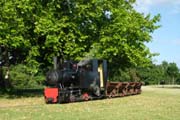
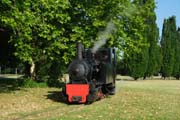
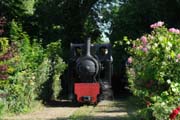
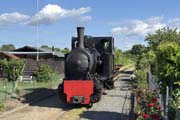
0-4-0T (CKD 1858/1940), visiting from a museum at Žamberk (Senftenberg) in Eastern Bohemia
For several years, the Bednář brothers have been operating a museum of old machinery and technology in the factory premises of the former Royan textile factory in Žamberk
(Senftenberg) in Eastern Bohemia. It is a truly "living" museum. The lower rooms of the factory house a steam
locomotive workshop belonging to the 1st Kolin Locomotive Company. Work on chassis is primarily carried out in Žamberk, while the repair and construction of new boilers takes place at
Kolin. There is now a 600 mm track system. From there, tracks lead up to the factory owner's villa, as well as into the winding courtyards of the old textile factory. Plans include the construction of a turntable and a locomotive shed to provide shelter for narrow-gauge vehicles. Part of the newly laid track is a three-rail track with 600 and 760 mm gauge. The old facade of the textile factory provides an excellent backdrop for the steam trains, even though there was no narrow-gauge railway here previously. I haven’t found out any info at all about the
locomotive’s career before preservation.
|
|
|
|
|
|
|
|
|

|
|

|
|
|

|
|
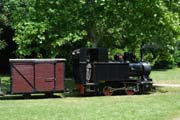
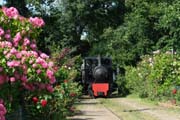
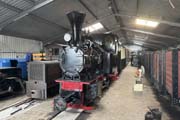
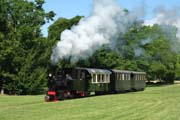
0-4-0T (MBA 13602/1944) visiting from a private owner in Gößnitz
This 600mm 50 HP O&K-type Bn2t steam locomotive 13602 from 1944 has found a new and hopeful home with a private owner in Gößnitz
in Thuringia. Delivered to a Mrs. Reckmann, who ran a construction business in
Halle. After 1945 it was at VEB Bau-Union, Frankfurt-on-Oder, and later used on the Erfurt Airport construction site. It appears to have been withdrawn in about 1974. It is now privately-owned, and after almost 6½ years it first steamed again on 13th August 2023. Both the Orenstein and the Koppel families were Jewish, and escaped Germany after 1933. After expropriation their business was renamed MBA in 1940, before becoming O&K again after WW2.
|
|
|

|
|
|
|


