|
This is one of a series of pages which cover the special
photographers' day on 30th May ahead of the main event over the
weekend..
Click here for
the overall index for the event.

|
|
|
12
|
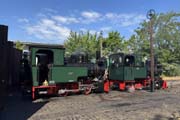
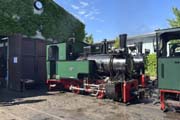
70hp Riesa class 0-4-0T no 12 (Henschel 28024/1948) was one of the last narrow gauge 0-4-0ts built in Germany, It worked at a colliery in Saxony until 1976, and arrived at Frankfurt in 2013.
|

|
|
|
|
|
|
|
|
|
13
|
30hp 0-4-4-0T Mallet no 13 (O&K 3902/1909) was one of many of these little locos built for the Dutch East Indies. It spent its working life at the Gending sugar factory in eastern Java, and its acquisition for the museum was negotiated by Dr Helmut Kohl, the German chancellor, while visiting Indonesia in 1996. It first ran at Frankfurt ten years later.
|
|
|
|
|
14
|
Not a feldbahn machine, 0-6-2T no 14 (Jung 989/1906) was no 1 “Jacobi”, the first of seven generally similar machines built for the Mecklenburg Pommersche
Schmalspurbahn, a public system more than 200km long in northern Germany which closed in stages until 1969. Four of the seven were taken by the USSR after WW2. “Jacobi” was preserved in the USA after 1970 and moved to Frankfurt in 1998. No 4 is preserved at
Friedland, the railway’s old operating centre, and no 7 is at the Vale of Rheidol’s museum at Aberystwyth after working for many years on the Brecon Mountain Railway.
|

|
|
|
15
|
90hp Fulda class 0-4-0T no 15 (Henschel 25180/1942) is one of the last two surviving locos of its type. It was delivered to the Holzmann construction company in Frankfurt and used in a sand and gravel pit at
Neu-Isenburg, now a nature reserve. It arrived at the museum in 2002.
Behind is 17.
|

|

|
|
16
|
To supplement the Brigadeloks from 1917 O&K built thirty four 0-10-0Ts for the German army, the first locos to use the new geared articulation system designed by Gustav Lüttermoller, their chief engineer. Thirty one more followed in 1921 and 1925 for the Japanese army, of which three were later sold to the Seibu Tetsudō (Japanese for “railway”) to work at its ballast quarry at
Ahina. No 16 (O&K 11073/1925), Japanese army no E103, is one of two to have survived, and first entered service at Frankfurt in 2014. Its sister no E18 is preserved at the “Feldbahnhaus” at
Shin-Egota, Tōkyō, home to an enthusiast publishing business specialising in German and Austrian railways.
|
|
|
|
|
17
|
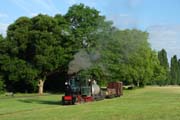
55hp 0-4-0T no 17 (Krauss 7656/1921) worked at first on the Spitzingsee Forest Railway, and moved to the Spiegelau Forest Railway in 1922. In 1930 it moved to the Zwiesel Forest Railway at
Oberzwieslau, close to the Czech border, which went on the be the last forest railway anywhere in West Germany. All these railways were in Bavaria. When the Zwiesel line ceased working in about 1960 it moved to the USA, and arrived in Frankfurt in 2014.
|

|

|
|
18
|
40hp 0-4-0T no 18 (O&K 9244/1925) was built for a company in Monchengladbach, and in 1935 moved to a contractor in Mayen which used it on the construction of the A4 autobahn. It was withdrawn in 1948 after working on the trümmerbahn (rubble-clearing railway) at Mayen after WW2. It arrived at Frankfurt in 2014 and was restored to working order the following year.
|

|

|

|
|
|
|
|
|
|
19
|
0-8-0T no 19 (Hanomag 10194/1923) came from a batch of fifteen locos constructed for Poland while the country’s new loco-building industry was becoming established. It was PKP no Tx4-559, and awaits restoration. Sister no Tx4-564 is preserved at Wenecja museum in central Poland. I couldn’t find it at the museum and presumably it is stored elsewhere.
|

|

|
|
20
|
Péchot-Bourdon 0-4-4-0T no 20 (probably Baldwin 43367 and French army no 215) is a real gem. These robust and well-designed machines, similar to the Double Fairlie though with just one centrally mounted dome, were designed by Prosper Péchot, an inventive army captain, and Charles-Alexandre Bourdon, a Decauville engineer. In addition to the sixty one pre-war machines 100 were built by Baldwin and thirteen by North British in 1915, and a further 180 by Baldwin the following year. Baldwin built just one more in 1921 for the Japanese army. The only others were two built in Russia by Maltsov 1899 for the Kovno fortress in Lithuania.
Probably more than sixty nine worked for the French military in north Africa and Syria after WW1, and a few were sold for service in Brazil, Yugoslavia, Poland and India. At least seventy eight remained in France, notably at the Maginot Line forts built after 1929. Many of them were removed by the Germans after they defeated France in 1940, and were mostly sent to eastern Europe, including the USSR, where one was still active in 1953. Two ended up at Kostolac colliery in Serbia. One of these, no 101, has also survived and is now at the Požega museum. The Germans scrapped others to recover the copper from their fireboxes, and probably few, if any, remained in France after the war.
No 215 was at Dessau in 1944, and in 1945 worked on the trümmerbahn at Magdeburg in what was then East Germany. It was later at Chemnitz, was restored for the Verkehrsmuseum Dresden in 1958 and arrived on loan at Frankfurt in 2019. Many French enthusiasts would dearly love to see one of the Péchots come back home in view of their significance to France’s railway history. Looted railway engines were supposed to be returned to their countries of origin under post-war accords, but these were ignored behind the iron curtain and claims are time-barred now. Maybe a sharing arrangement could be reached!
No 215 is missing significant components including the upper parts of its chimneys and its whistle, klaxons, toolboxes and number and works plates. There are photos of it working on the Maginot line under the Germans, and some of its plates were missing even then. There’s no present plan to restore it to working order.
|

|

|
|
21
|
0-4-2T no 21 “Gazengo” (Jung 847/1905) was built for the Bom Jesus sugar estates in Angola. It ended up at the Sandstone railway in South Africa and moved to the museum in 2024. It is currently being restored and it looked as though the work is nearly finished. I thought it was especially attractive with its side tanks, scanty cab and trailing truck.
|
|
|


