|
This is one of a series of pages which cover the special
photographers' day on 30th May ahead of the main event over the
weekend..
Click here for
the overall index for the event.
|
|
|
|
1
|
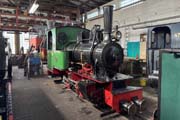
0-4-0T No. 1 “Besigheim” (Heilbronn 393/1900) was built as a 720mm gauge loco for a salt works at Friedrichshall, on the River Neckar near Heilbronn. It was later moved downstream to a cement factory at Lauffen am Neckar and was converted to 600mm gauge.
|
|
|
|
2
|
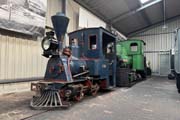
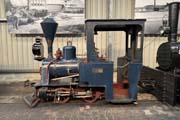
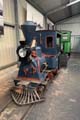
Fabian-type 50hp 0-4-0T no 2 (Henschel 20517/1925) was delivered to a civil engineering trade association in Cologne. And ended up with the Karl Rothenburger construction company in Aschaffenburg until withdrawn in 1954.
|
|
|
|
3
|
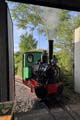
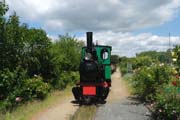
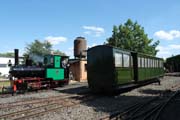
At just 5hp 0-4-0WT no 3 (Jung 255/1896) is possibly the tiniest 600mm loco ever, and with its disproportionately large cab it would perhaps feel more at home on the 7¼” gauge! It was built for the Ferrocarril de Tacubaya, a pleasure railway in Mexico City about 1.6km long. It proved to be too small despite the line’s undemanding requirements, and the following year the 20hp 4-4-0 “Susana” (Baldwin 15241/1897) took over most workings. Although four times more powerful “Susana” was still the smallest loco which Baldwin built for commercial service. The railway was rebuilt as a part of the city’s tramway system in 1910, and the Jung loco continued to be stored under cover, latterly at a factory close to the international airport, unbeknown to the outside world. I spent a whole day waiting for a plane at the airport in 2012, and if only I’d known it was nearby! The loco was discovered in 2023 by a team from Frankfurt and brought to its new home in January 2024. Because it was seldom used in Mexico it’s still virtually in as-new mechanical condition.
|
|
|
|
4
|
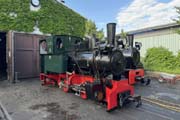
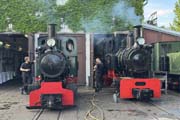
40hp 0-4-0T no 4 (O&K 2053/1906) was built for the Ernst Pack construction company at
Letmathe, in North Rhine-Westphalia, and may have been used in Finland in the 1930s. It worked until about 1961.
|

|

|
|
|
|
|
|
|
5
|
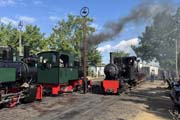
Hilax-type 65hp 0-4-0T no 5 (Jung 9295/1941) was delivered to the Fernie brownstone mine at
Giessen, north of Frankfurt, later run by Faber & Schnepp, and after a period out of use worked for them at
Gro-Benlinden, near Giessen, between 1951 and 1956.
(The second picture shows the Budich on the right, these are both Faber
and Schnepp locomotives.)
|
|
|
|
|
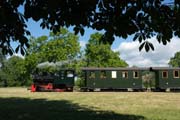
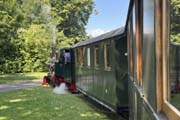
James very wisely took a break from the celebrations in the late morning
and took a ride back to the yard.
|
|
|
|
|
6
|
60hp Monta class 0-4-0T no 6 (Henschel 22826/1935) worked for the Peter Buscher construction company in Dortmund, and spent many years in preservation in the USA until arriving at Frankfurt in 2019.
|
|
|
|
|
7
|
Decauville’s 8-tonne type 17 Progrès class 0-6-0Ts were built from 1911, specifically to compete with German feldbahn designs. The French army’s preferred locos were the Péchot-Bourdon 0-4-4-0Ts dating from 1887, but only sixty one had been built by the start of WW1, and none since 1906. They urgently required many more, and as well as more Péchots, Baldwin 0-6-0STs and, later,
i/c machines, they bought 147 type 17s and seventy Kerr Stuart Joffrés, close copies, between 1914 and 1917, including no 7
(Decauville 1593/1915). Many were sold after the war, mostly into industry, and several survived to be preserved. No 7 later worked in Greece.
|
|
|
|
|
8
|
2,573 Brigadelok 0-8-0T+Ts, with Klien-Lindner articulation, were built as the German army’s principal feldbahn loco type between 1903 and 1919. No HF312
(Borsig 8836/1914), the museum’s no 8, is the oldest of 101 to be preserved. From 1921 it worked on the Waldeisenbahn
Muskau, which was run by Deutsche Reichsbahn between 1951 and closure in 1977 and is now a flourishing heritage railway. No 8’s tender came from no HF426 and was recovered from Bulgaria.
|
|
|
|
|
9
|
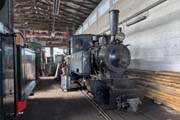
0-4-0T+T no. 9 (Henschel 16047/1918) is one of 114 locos built between 1916 and 1918 for the German army to work on temporary 600mm lines through the mountains of southern Turkey, filling in gaps in the uncompleted but strategically important Istanbul-Baghdad railway. Some which were unfinished at the end of WW1 were delivered instead to the Spanish military, including this loco which went first to Spanish Morocco. It later worked at the Cuatro Vientos army railway base near Madrid, and in 1962 was sold to Utrillas colliery near
Zaragoza. Initially preserved at the South Tyndale Railway, it moved to Frankfurt in 2018. I saw it being overhauled when I visited in 2019. Its boiler was stored in 2025 and I couldn’t then find the rest of it.
|
|
|
|
10
|
Also resident at Frankfurt since 2018 is the pretty 0-6-0T no 10 (Henschel 13070/1917). It’s the only survivor of four prototypes built for the German army to try out, and was basically developed from Henschel’s Fabia design like the museum’s no 2. The army opted for an O&K type instead, but the Austrian army later took on Henschel’s design as their R111c class. Originally allocated number 478, it spent many years after 1925 in industrial service at Ecaussines in Belgium.
|
|
|
|
|
11
|
0-6-0T no 11 (Jung 10137/1952) is one of two similar locos imported from the Dalmia cement factory in
Orissa, India, in 1988 where it was no 2. They are examples of the German army’s WW2 HF110C design. These locos were mostly built for service in the USSR, principally in eastern Ukraine which the Germans intended should become a breadbasket for Germany proper, and where they built many 600mm gauge railways to transport produce to mainline railheads. They realised this was not a viable long-term project after their defeat in 1943 at the Battle of Kursk (then, as now, a contested district) and these two may have remained on their builders’ hands after the war until eventually sold.
|
|
|


