|
James Waite writes about a trip to some of the lesser known museums in
Sweden.
I made a brief trip to Bergslagen, the iron-mining district to the west and north-west of Stockholm, and saw some museum
locomotive s I'd never got around to visiting before. Here are some photos.
The museum at Koping
 |
This is at the western end of Lake Malaren dedicated to preserving stock and relics from the Koping-Uttersberg
Jarnvag, a 1093mm gauge line built from 1864. The locomotiveis the railway's no. 7
"Patric Reutersward" (Nohab 390/1894). The line acquired its gauge by accident as it was built as a 3ft 6ins gauge line, and would have been only the second in the world with this gauge after the line in Norway built two years earlier. 3ft 6ins equals 3.59 Swedish feet but due to a misunderstanding between the railway and Munktells who built the first
locomotive s there were built to 3.59 British feet instead of Swedish which equals 1,093mm and the line was altered to suit. I was told there are unconfirmed reports that the first wagons and carriages were built to a different gauge again! Many early Swedish railways were built with British finance and expertise as you'll know from your trip to
Gavle, hence the scope for confusion between British and Swedish feet. |
 |
The society has around two hundred yards of track at the harbour at Koping where they run a diesel converted to the gauge by the SJ after the line was
nationalised. They may eventually finish the restoration of the steam
locomotive though it needs major work on the firebox which they can't afford at present. |
The Surahammar Bruksmuseum

 |
 |
 |
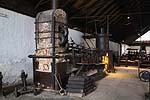
This is an old ironworks opened in the early 1800's and which moved on to more modern premises in the town after which the old ironworks closed in about 1903. Most of the machinery was left in situ and the premises became a museum in about 1920. In 1865 they acquired a contract from SJ to manufacture rolling stock wheels and these have been made in the town ever since. |
 |
 |
 |
|
 |
 |
 |
The tiny 0-4-0T was built for their railway west from Surahammar to Lisjon, mainly to carry wood to provide charcoal for the iron furnaces. It closed in 1926 and the
locomotive, a wagon and a coach used for providing free passenger transport have been preserved in the museum ever since. It's Kristinehamn 17/1876 and was the only
locomotiveever to run on the line. The gauge was also 1093mm to allow for a possible connection with the KUJ whose route ran close to Lisjon but this never took place. |
The Frovi Bruksbanemuseum
 |
This is OK 2808/1908 which worked for the Gota Sulfitfabrik as their no. 3 and is undergoing a radical
rebuild from 891mm to 600mm gauge. |
 |
This shows a locomotive which at first I thought must be a steam-outline diesel though in fact it's a new-built chain-driven steam
locomotive . I think it is built on the chassis of a petrol or diesel
locomotivebut couldn't properly understand what the gentleman who showed me around was saying about it. |
 |
4483 is 760mm gauge Hoganas Bruk no. 3 (Krauss Munich 1320/1883). |
The old goods shed at Nora station
 |
 |
This a newly-opened museum in the old goods shed at Nora station on the standard gauge Nora Bergslags Veteran Jarnvag. The
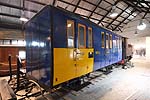
locomotiveis no. 4 from the 802mm gauge Bredsjo-Degersfors Jarnvag which ran close to Nora. |
 |
|
The coach is also from the line. There's a standard gauge Fox Walker 0-6-0ST also on display here but unfortunately it's in a quite unphotographable position. The line has several preserved main line
locomotives in the roundhouse at Nora but I wasn't able to visit this. |
The Hagfors Jarnvagsmuseum
This is more than an hour's drive north from Nora and not far from the Norwegian border. The stock all comes from the 891mm gauge Nordmark-Klaralvens Jarnvag, a lengthy system which served the old ironworks in and around Hagfors and which was electrified from the 1920's.
 |
 |
 |
 |
No 1 "Ua" (Hughes, 1871 and their oldest surviving
locomotive anywhere) was built as a 0-4-0ST like their Corris
Railway locomotives in the UK and like them was altered to a 0-4-2ST a few years later.
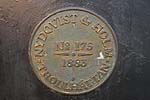
The plate is on its boiler. |
 |
 |
 |
 |
0-6-2T no. 5 "Louisa Tranaea" is Avonside 1114/1875 and no. 7 "Hagfors", also a 0-6-2T, is Nohab 175/1883. |
 |
 |
 |
 |
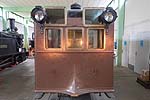
The steam railcar with the optimistically streamlined front is Wallberg & Ludviks 10/1900. It seems to have been regarded as an inspection vehicle rather than a railcar for public service. |
|
|


