|
Steam Survivors in Asturias, Spain, 2012 |
|||||||||||
|
James Waite reports on a busy and (mostly) successful two days in Asturias. Since this report was written, Gijon museum's VA 2-8-2T 8 (BW 727/1958) one of the last steam locomotives built in Spain, has been returned to service, there are pictures of a trial run on the museum's Facebook page https://www.facebook.com/MuseoFerrocarrilAsturias/ (added 8th June 2018). The main object of the trip was to visit the Asturias Railway Museum at Gijon on one of their infrequent steaming days though, as things turned out, the small broad gauge shunter which was due to have been in action failed and the rides on offer were being given by the museum's German-built Kof-type loco. The district to the south and south-east of Oviedo was, and to some extent still is, heavily industrialised with numerous railways of varying gauges serving the coal mines and steelworks there. Many of the railways continued to be steam-worked until the early 1970's and many of us will have happy memories of journeys there to visit them. The Asturias museum is a no-expenses-spared type of place which must have received an enormous amount of public funding to set it up in the late 1990's. It's housed in the old Norte and RENFE station in Gijon though the station building itself must have been given a very extensive make-over to make it into something similar to a purpose-built museum building. At the far end of the yard is a new building where the majority of the locos are housed and which also accommodates a repair shop. It's an adventurous building but is perhaps not wholly successful as a place in which to display the exhibits. Many of them are distinctly cramped and it can be hard to stand far enough back to admire them properly. More exhibits are displayed outside. Most of the steam locos in the museum were either built for the industrial railways or owe their survival to having been sold off into industrial service. The region's public railways operated for many years on three gauges, the RENFE broad gauge system which it inherited from the Norte, the metre gauge systems of the Economic Railways of Asturias which ran mostly parallel to the coast and the Vasco-Asturiano which ran inland from Oviedo to serve much of the heavy industry and also down to the coast at San Estaban and the 4ft 8½in (1435mm) gauge Langreo railway, the oldest line in the country which also served some of the main industrial districts. While the gauge may have been to the European standard the Langreo must have felt more like a narrow gauge one in many ways with slow speeds and small, mostly antiquated rolling stock. Both it and the metre gauge lines were taken over by the state-run FEVE organisation after they ceased to be profitable. The Langreo was converted to metre gauge in 1982 and, along with the busier parts of the other lines, are all now electrified. The Museo de la Minera at El Entrego and the Museo de la Siderurgia de Asturias nearby at Langreo also have preserved locos. There are many others plinthed throughout the region, some of them in public places and some at the region's surviving collieries and steelworks. We didn't get either to the Langreo museum or to many of the plinthed locos. Full details of all the region's surviving steam locos are at http://www.locomotoravapor.com/asturias.htm. The first two of these photos show 550mm gauge O&K 0-4-0T 10995/1922 "Rojillin" at Salinas, on the coast very close to Asturias airport. It's on the trackbed of an old 800mm gauge line serving Arnao colliery which tunnelled through a headland at this point, one of the the tunnel mouths being just behind the wagon in this photo. The colliery was run by the RACM and one of its locos, a Couillet 0-4-0T 0-4-0T 469/1880 has recently been restored and is on temporary exhibition in the Gijon museum. This O&K was built as a 600mm gauge loco and was regauged by the O&K factory in 1925 from the Reocin colliery line near Santander where it spent its working life.
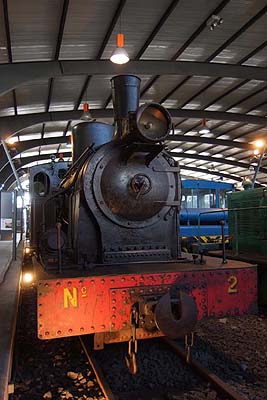
This elderly Neilson 0-4-0ST spent much of its working life as FC Andaluces no. 03 before being sold to the Tudela Veguin cement company which ran two factories near Gijon. It still carries its Andaluces numberplates and so I guess it must have been sold by them before the RENFE was formed. It's now housed at their factory at Abono and you'd definitely need to ask for permission in advance to visit it as it's tucked away well inside the factory premises. We really liked the substantial shelter under which the loco lives - a bit like a traditional Spanish station roof! The factory's staff were very welcoming and I'm most grateful to them for arranging our visit.
RENFE 0-6-0 030-2431 (Hartmann 1112/1881) came from the Norte and ended up in colliery service. It's restored as Norte 1672 and is one of three of the Gijon museum's steam locos which stand under the old train shed at the museum which is housed in the old Norte terminus station in the city.
0-4-0T "Coronel Esteban" (MTM 46/1910) spent its working life at the government arms factory at Trubia west of Oviedo.
1435mm gauge FC Langreo 0-6-0T 30 1057/1910 is preserved with a train of two Langreo coaches.
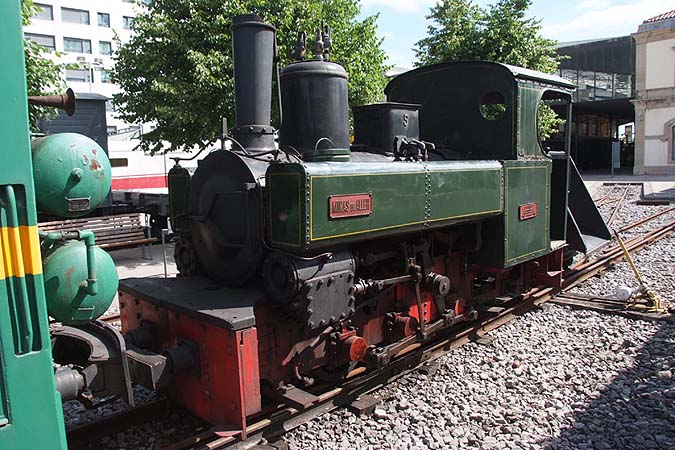
This is unusual 600mm gauge SHE 0-6-0T 5 from the Minas de Aller, a very pretty engine in my view with its Brown indirect drive. It's one of three survivors of this class of five. One of the others is now at the Statfold Barn Railway and has recently been restored to working order. The third is at Lousal in southern Portugal. I made a vain attempt to see these locos in action in 1970 and got as far as Ujo station, around 1km from the Minas de Aller depot, but then ended up heading on foot in the wrong direction towards the broad gauge Turon system instead!
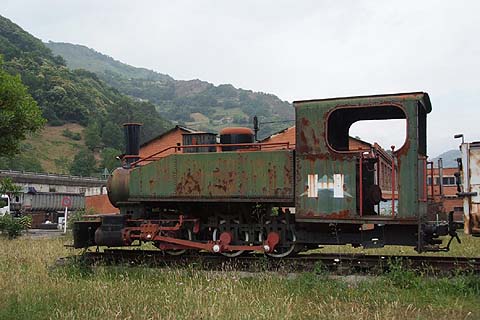
The last Minas de Aller loco, 0-4-0T "D" is from a separate high level line whose locos bore letters instead of numbers. It's Maffei 3946/1920.
Fabrica de Mieres 650mm gauge 0-6-0T 111 "Santa Barbara" (Jung 1134/1907) stands out in the open at the museum.
This is Mieres broad gauge 0-4-0T 304 which they acquired from the RENFE in 1958. It had been RENFE 020-0223 and was originally FC Triano no. 6 (Sharp Stewart 2787/1878).
1000mm gauge Vasco-Asturiano 0-6-0T 21 "Nalon" (Hunslet 783/1902) ended up as in industrial service at Figaredo, near Mieres
This is broad gauge Cockerill 1712/1891 from the RACM and I haven't yet found out where it worked.
Turon home-built broad gauge 0-6-0T 120 is the only engine in the museum which I saw during its working days during my abortive attempt to get to the Minas de Aller depot in 1970!
Here are two views of 1000mm gauge Solvay 0-6-0T 2 (9475/1909) which ended up working at the Llieres mine east of Oviedo.
This is JOP (the Gijon port authority) broad gauge 0-8-0T 13 (Babcock & Wilcox 725/1957) with their 0-6-0T 11 (BW 726/1957) behind.
750mm gauge 0-4-0ST no. 1 (VIW 2497/1916) is one of several US-built locos to work at a colliery at Moreda, a little further up the Aller valley from the Minas de Aller.
Broad gauge SA Felgueroso 0-4-0T no. 1 (Henschel 24924/1952) should have been in steam but had failed.
Arnao Couillet "Elenore" is on temporary display, a delightful loco but squeezed into an almost unphotographable position under the stairs!
Finally a general view of most of the exhibits in the modern building at the western end of the site.
The next three photos are of four locos at the Museo de la Mineria at the old Santa Ana colliery in El Entrego, another place I visited in 1970. The first is of Duro-Felguera 650mm gauge 0-4-0T no. 26 "Pilar" (Borsig 8505/1912) with, to the right, broad gauge RENFE 0-6-0T 030-0232 "Palau" (MTM 5/1887) which ended up at the Minas de Aller.
650mm gauge Linke Hofmann 0-4-0T 1908/1920 is from the Tranvia Laviana-Rioseco in the wild and steeply-sided Nalon valley upstream from El Entrego and which ran a free passenger train until it closed in 1968. It must have been a delightful line!
600mm gauge 0-4-0T "Upinas" (Krauss Munich 2345/1880) ended up at Mieres.
The final 4 photos are at Pozo Santiago, the surviving Minas de Aller pit. We first tried to get there on our first day in Asturias but were stopped by a Civil Guard person a couple of km before arriving there and told that both the roads up the valley were closed. We went again the following morning and found a large crowd at the mine being addressed via a loudspeaker by someone who was clearly a union official beneath an effigy of a gentleman in a suit who was being hanged from the winding gear and with hammer and sickle flags all around. At least the barriers were open and the security people were just watching the people and their cars coming and going - in any other circumstances I guess we would probably have been refused admission. There were several newish BMW's and Audis etc. amongst the parked cars so our shiny hired Citroen Picasso didn't look out of place. There were quite a lot of families there so we figured that the crowd wouldn't turn violent and we just drove in to find the colliery's two preserved locos. It later transpired that the Spanish government has recently substantially reduced the subsidy to the country's collieries at the behest of the EU and this is likely to force the closure of the pit. There are three miners who have barricaded themselves down the mine and were on the 41st day of a hunger strike. Their supporters had started a large fire started on Friday at a barricade on the main road and one of them was filmed firing a home-made rocket at a low-flying Civil Guard helicopter, fortunately without causing an injuries. The 0-6-0ST is Minas de Moreda no. 2 (VIW 2511/1916) and the side tank is Minas de Aller 9 (ALCO 58657/1918). Finally the 600mm gauge line within the colliery is still in use and the last photo shows some of the locos and wagons.
|
|