|
This is one of a series of pages which I have uploaded to
illustrate facets of steam rallies we have attended in the UK.
Such events occur all over the country in the summer months, they are easily
found by using your favourite search engine and may have anything between a
handful of steam engines and hundreds (as at the Great Dorset Steam Fair
which could probably be fairly described as having an excess of riches). Click here for
the overall index for 2025.
Realisations for the four road engines have
now been added (30th July 2025)
Tucked away down a country lane in the foothills of the
Forest of Dean at Churcham just west of Gloucester is the Severnside
Engineerium (Museum), established by father and son Price as a treasure
house of steam power. Known only to a privileged few steam enthusiasts (and
certainly not this one until very recently even though it is less than 10
miles form my home), it held 'open days' until a few years ago when local
farming customers and friends would gather to marvel at the display. I am
sure this was partly because they never sought publicity but mainly it was
because their insurance policy limited the numbers on site at any time. Now
the father is gone and the son's failing health means that the time has come
to close the doors on it.
H.J.Pugh in Ledbury (https://www.hjpugh.com)
is a major
auctioneer which occasionally includes a road engine or two in their regular
auctions including those at Welland and Much Marcle steam rallies. Click
here for one such in 2025. Now they are selling off the collection on 30th July 2025 (details easily found
on the Pugh website). Prior to the sale, Rod Smith arranged for the two of
us to visit on 9th July 2025 and it was an absolutely fascinating experience
to see the collection and talk to Mr.
Price about it and how it came to be what we saw in front of us.
Most readers of this page will be interested in the four
Marshall, 'road engines', 3 of which appear in the TER. Here are 2 of them,
to me the most interesting was the semi-portable engine of 1886.

What follows below is a (personal) selection
from the stationary steam engines present, the notes are from the auction
catalogue, lightly edited for consistency. Not shown is an amazing
collection of bric-a-brac, tools, machinery and spare parts from a time when
Britain was still making 'stuff'. Mere photographs could not possibly do
justice to what is on display. What makes it extra special to me is that
most of it has connections with Gloucester and the Stroud valleys where I
grew up. Of course, by then such things were rapidly falling out of use,
hidden indoors invisible to passers-by and my steam education was
concentrated on the Chalford railcar and the 'Castles' at the head of the
Cheltenham Spa Express which I usually saw hurtling past as I rode my bike
to school in Stonehouse. Most of these engines worked locally and some,
indeed, were also made in the area. It's a screaming shame that there is no
practical way the collection could be kept intact.
|
|
Notes
|

|
This extremely rare steam engine is believed to be the only surviving
engine built by H. Tittley at Alton Works, Smethwick. The company
started during the early 1870s manufacturing line shafting, pulleys and
bearings. We do not know the history of this engine but we believe it
was built to power a hoist due to its unusual valve gear. It was used in
its later life to drive a mortar mill in a brickworks at Stonehouse,
Gloucestershire. It is in good working order
|

|
Built in 1934 by Sissons of Gloucester for the John Carr Factory. It is
a compound piston valve engine with 8" and 12" diameter
cylinders, with a 6" stroke. Engine no. 3368, It has been fully
refurbished and is in good working order.
|

|
Built in 1923 by Sisson of Gloucester no. 2229. This high speed engine
is coupled to a generator which can power the museum lighting. It has a
4" diameter cylinder, with 3" stroke, runs at 700rpm and is in
good working order.
|
|
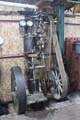
This is a reversible vertical Sisson marine steam engine no. 1373. It
has a 6" diameter cylinder, 8" stroke and dates from ca 1915.
It is in good working order.
|

|
This is a George Waller and Son steam engine, built at the Phoenix
Ironworks, Brimscombe, Stroud. It has a 10" diameter cylinder with
8" stroke. It was used to drive a rack saw bench in Hereford ca
1915 and is in good working order.
|

|
This is John Wood steam winch no. 1308. It has twin 6" diameter.
cylinders, with 8" stroke. It is in good working order.
|
|
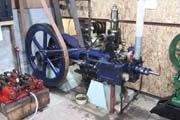
This is a Frank Pearn steam engine built in 1912, one of six installed
in a London sewage works. It has a 10" diameter cylinder with
10" stroke and is in good working order.
|

|
This is a Joseph Evans steam pump, built in 1918 for a Caerphilly tar
works. It is an unusual piston valve pump which can be reversed to
unblock the pump. The cylinders are reported to be 8" x 6" x
9". It is in good working order.
|
|
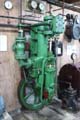
This is a Frank Pearn banjo type wall pump ca. 1925. It has a 6"
diameter cylinder with 6" stroke and is in good working order.
|
|
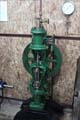
This is Lion banjo type steam pump no. 27578 ca. 1905. A. It came from a
paper mill near Exeter and is in good working order.
|
|
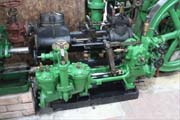
At the rear is black Hayward Tyler duplex steam pump no BR47069, with
6" x 4" x 6" cylinders. It is in good working order.
In front is a rare horizontal type Weir steam pump ca. 1925 which is in
good working order
|

|
This is a Hawthorn Davey steam pump, built in Manchester in 1881 and is
one of the smallest to feature the Scotch crank design. It was
commissioned by the company to supply water to a fountain of a large
country house in North Wales. It is in good working order, with 3½"
diameter cylinder, and 5" stroke.
|

|
This compound Frank Pearn twin banjo plunger pump assisted the first
mains water supply in the Cheltenham area ca. 1918. It is in good
working order
|

|
This is Sisson steam engine no. 6283, built in 1964. It is the smallest
version of their slow speed instructional engines supplied to the
Plymouth Naval Training Base at Devonport, with dynamometer, flywheel
and engine indicator. It is in good working order.
|

|
This is Bellis and Morcom steam turbine no. 1296. Built in the early
1960s, this unit was made for the Plymouth Naval Training Base at
Devonport. It is a fully operational turbine and dynamometer used for
the training of ships' crews and other engineers. Updated in the 1980s
to a fully electronic/diagnostic plant, it comes with condenser, vacuum
pump and control panel.
|

|
On the left is Sisson steam engine no 5060. It has a 6" diameter
cylinder with 4" stroke. This slow speed instructional engine was
built in 1959 for the Gloucester Technical College. It is fitted with an
adjustable expansion valve, engine indicator and a dynamometer flywheel.
This unit includes a condenser, vacuum pump and a convergent-divergent
steam nozzle that can achieve Mac 1 supersonic speed
On the right is a Lilleshall steam engine. This duplex barring engine
was a small part of a very large engine. Its purpose was to move the
main engine into either its starting position or to position it for
maintenance. It has 6" diameter cylinders with 6" stroke and
is in good working order
|

|
This must be the original 'steam radio'. It dates from World War 2 when
there was a need for a quiet method of charging batteries for
clandestine spy radios and where no other supply was available. It was
designed and produced by Stuart Turner of Henley-on-Thames and at 100
pounds (45kg) it was 'luggable' rather than truly portable, designed to
be delivered by parachute.
It had a single cylinder piston valve engine combined with an inbuilt
alternator with a metal rectifier giving 6 volts at 8 amps. It also had
a unique variable stroke feed water pump and an integral injector pump
for supplying the cylinder lubricating oil. The engine was built into a
steel cradle with a canvas carrying handle. together with a spanner for
connecting the pipe-work.
The boiler set was in 3 sections; the grate, firebox and horizontal cast
aluminium boiler. Fitted to the boiler were a heavy-duty water level
sight glass, a pressure safety valve and a superheater coil to supply
steam to the engine. The chimney was in three sections and incorporated
a connection for the steam exhaust from the engine to maximum effect.
The working pressure was set for 60 psi. All connecting pipes were
colour coded to ensure correct connections.
|
|
|


