Great Challenge 2018
(Cable) Steam Ploughing Engines
This is one of a series of pages which I have uploaded to illustrate facets of steam rallies we have attended in the UK (since 2013). Such events occur all over the country in the summer months, they are easily found by using your favourite search engine and may have anything between a handful of steam engines and hundreds (as at the Great Dorset Steam Fair which could probably be fairly described as having an excess of riches). Click here for the Great Challenge index and click here for the overall 2018 index.
I have added some extra data on this occasion to illustrate the comprehensive nature of exhibits. The class nomenclature is less than transparent, but all are twin cylinder compound engines except for those designated SC (= Single Cylinder). Some idea of relative size is given by the Nominal Horse Power, although the engines are actually far more powerful than the numbers suggest. Normal ploughing engines were supplied in matched pairs, they are indicated R(ight) and L(eft) according to the direction the cable runs out when looking forward from the footplate, with Fowler the lower number of a pair was traditionally given to the right hand engine, although some pairs later swapped over drums etc to even out wear on gears. The road registration numbers were a 1920s innovation so consecutive numbers do not necessarily indicate an original pairing which would normally carry successive manufacturer's numbers.
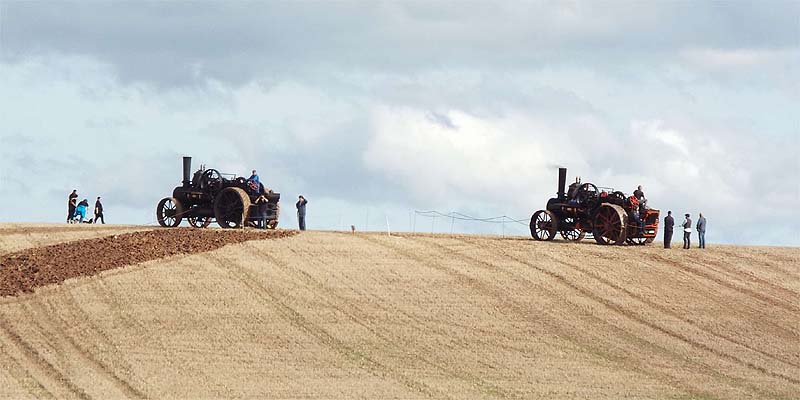
With so many engines working so close to each other, routine whistling, save for urgent stopping, was forbidden and operation was by hand signal. Some of the engines on the ridge were hidden from those below and in this case a flagman was stationed where he could see both. You can see one in the Set L section.
The data for the ploughs is taken from the circulated pre-event list, I made no attempt to check that they were the ploughs actually used, but I think the number of blades matched in each case. Standard ploughs are designed to turn the soil through 135 degrees, while diggers are intended to completely invert the soil. All those in use were reversible double ended, the anti-balance type can shift the centre of gravity forward so the weight of the exposed part will not tend to lift the buried part out of the ground.
|
Maker |
Number |
Class | NHP | L/R | Registration |
Notes |
|

|
Fowler | 14213/1914 | BB | 14 | R | HK 9840 |
"Bob" Tinkers Park Rally 2018 Picture Weald of Kent Rally 2019 Picture |

|
Fowler | 15257/1918 | AA7 | 18 | L | BW 4637 |
Fawley Hill Rally 2014 Picture Tinkers Park Rally 2015 Picture Crockey Hill 2016 Picture Great Dorset Steam Fair 2018 Picture |

|
Fowler | 12947 | 5 furrow shallow, anti-balance with bevel frame | ||||

|
|
|


This set was the
overall runners up for the Challenge Cup.
The crew consisted of David Nourish, Peter Wilson, Charles Teall, Archie Sains and Joe
Nourish.
The ploughman, Joe Nourish won the Beeby Brothers Memorial Cup awarded to the ploughman producing the best work by a digger plough.
This was the only true pair present.
|
Maker |
Number |
Class | NHP | L/R | Registration |
Notes |
|

|
Fowler | 15182/1918 | BB1 | 16 | R | HO 5869 |
"Achilles" Marcle Rally 2013 Picture SPC Hands-On 2018 Picture SPC Hands-On 2021 Picture |

|
Fowler | 15183/1918 | BB1 | 16 | L | HO 5868 |
"Ajax" |

|
Fowler | 12861 | 4 furrow semi digger, anti-balance with bevel frame | ||||

|
|

15564 is the 'wrong' hand, it will have started life left handed as it was paired with 15563. It is believed they were rebuilt during their working life on Lord Rayleigh's Estate, I was spurred to ask about this by the discovery that 13880 and 13881 were similarly reversed (in this case to confuse matters 13880 was again reversed in preservation.).
|
Maker |
Number |
Class | NHP | L/R | Registration |
Notes |
|

|
Fowler | 15564/1920 | AA | 18 | R | NO 374 |
"Wanderer" |

|
Fowler | 2528/1875 | SC | 14 | L | AL 8345 |
"The Chief" |

|
Fowler | 13224 | 5 furrow shallow, anti-balance with bevel frame | ||||

|
|

The John Bush Tankard was awarded to Jim Clark, the driver of the engine judged to show the highest standard of skill and ability during the course of the competition. Jim was driving Fowler 15145 “Rusty” for Alan Sparkes.
|
Maker |
Number |
Class | NHP | L/R | Registration |
Notes |
|

|
Fowler | 15222/1918 | BB1 | 16 | R | CT 4289 |
Crockey
Hill 2016 Picture Abbey Hill Rally 2019 Picture |

|
Fowler | 15145/1918 | BB1 | 16 | L | CF 3348 |
"Rusty" Crockey Hill 2016 Picture |

|
Fowler | 2 furrow shallow special sub soil | |||||

|
|
|


|
Maker |
Number |
Class | NHP | L/R | Registration |
Notes |
|

|
McLaren | 1552/1919 | 16 | R | BD 5504 |
"Hero" Fawley Hill Rally 2014 Picture Old Warden Rally 2014 Picture Crockey Hill 2016 Picture Trevithick Day 2018 Picture Great Dorset Steam Fair 2018 Picture Great Dorset Steam Fair 2019 Picture |
|

|
Fowler | 15529/1921 | BB1 | 14 | L | UA 1876 / EJW 510 |
Abbey
Hill Rally 2014 Picture |

|
Fowler | 11300 | 3 furrow deep digger, balance | ||||

|
|

|
Maker |
Number |
Class | NHP | L/R | Registration |
Notes |
|

|
Fowler | 1368/1870 | SC | 12 | L | AL 8468 |
"Margaret" |

|
Fowler | 15436/1920 | BB1 | 16 | L | NO 1364 |
"Princess Mary" |

|
Fowler | 13271 | 6 furrow shallow, anti balance bevel frame | ||||

|
This set won the
overall Challenge Cup. The crew consisted of Tracy Vine, Douglas Fitzpatrick, Ian Stewart and Andrew Pierce with Peter Denham on the plough. Richard Pierce and Peter Stanier are the owners of Fowler 2861 and Fowler 3195, the two 8hp singles at work.
Peter Denham won the Mike Beeby Cup awarded to the ploughman producing the best work by a shallow plough.
The Gold Medal was awarded to Richard Pierce and Peter Stanier - owners of the 4 furrow, shallow, bevel frame, balance plough number 1514.
The successive registrations presumably indicate that these were working as a pair when that system was introduced in the 1920s.
|
Maker |
Number |
Class | NHP | L/R | Registration |
Notes |
|

|
Fowler | 3195/1877 | SC | 8 | R | AB 9452 | Crockey Hill 2016 Picture |

|
Fowler | 2861/1876 | SC | 8 | L | AB 9451 |
Weald of Kent Rally 2016 Picture Crockey Hill 2016 Picture |

|
Fowler | 1514 | 4 furrow balance, angle iron frame | ||||

|
|
|


|
Maker |
Number |
Class | NHP | L/R | Registration |
Notes |
|

|
Fowler | 14380/1917 | BB conv | R | NK 1755 |
"Sally" Diesel Conversion Fawley Hill Rally 2014 Picture Fairford Rally 2014 Picture Crockey Hill 2016 Picture Great Dorset Steam Fair 2018 Picture |
|

|
Fowler | 15148/1918 | BB1 | 16 | R | CT 4663 |
Kelsall Rally
Picture Crockey Hill 2016 Picture Cheshire Fair 2018 Picture |

|
Fowler | 15130 | 4 furrow deep digger, anti-balance | ||||

|
|
|


|
Maker |
Number |
Class | NHP | L/R | Registration |
Notes |
|

|
Fowler | 15451/1925 | BB1 | 14 | R | SD 9378 |
"Victory" SPC Hands-On 2018 Picture SPC Hands-On 2021 Picture |

|
Fowler | 15673/1922 | Z7 | 22 | L | F 49 UXF |
Formerly at Sena Sugar Estates, Mocambique |

|
Fowler | 13689 | semi-digger anti-balance, bevel frame | ||||

|
|
|


Thos set was placed
3rd overall for the Challenge Cup.
The team consisted of Peter Stanier, Colin Wakeford, Jon Maynard, Paul Ransley, Duncan Pierce, Roger Luck and ploughman Mark Fisher. The engines were Fowler-Burrell number 1050 and Fowler AA6 number 13877 owned by Richard Pierce and Peter Stanier respectively.
1050 is the oldest surviving Fowler ploughing engine.
|
Maker |
Number |
Class | NHP | L/R | Registration |
Notes |
|

|
Fowler - Burrell | 1050/1868 | SC | 16 | R | KE 2319 |
Rebuilt with Burrell Single Crank Compound Cylinders ca 1911/2. "Heinz" Weald of Kent Rally 2019 Picture |

|
Fowler | 13877/1917 | AA6 | 16 | L | NO 5 |
Tinkers
Park Picture Weald of Kent Rally 2016 Picture Crockey Hill 2016 Picture Tinkers Park Rally 2018 Picture Weald of Kent Rally 2019 Picture |

|
Fowler | 11700 | 5 furrow shallow anti-balance, bevel frame. | ||||

|
|
|


