 |
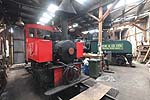
0-4-0ST B10 (Hudswell Clarke 1542/1924) at the Oamaru Steam & Rail Museum. The
locomotive spent its working life at the Waitaki Farmers Freezing Co. It's the pride and joy of the association which runs the museum and should be in working order. However its tubes have become unserviceable not long after being fitted and the steel from which they were made is now being analysed to try to establish the cause of the problem. |
 |
The museum is housed in the old harbour board's locomotive shed in the historic port area at Oamaru. It's the city where the trade in shipping frozen lamb to the UK was first established and there are lots of interesting 1800's industrial buildings around the harbour, now put to a variety of tourist-related uses. The skeletal remains of several steam
locomotives which had been dumped on the foreshore to provide coastal protection have now been put on show. This is the power bogie of an R class single Fairlie 0-6-4T. 18 of these
locomotives were built by Avonside from 1879 and were regarded as being generally successful. At least one continued to work for the NZR until the early 1940's although officially the last of them was withdrawn some years later. There's one complete survivor, see below! |
 |
The Steam Incorporated train a couple of
kilometres out from Oamaru. |
 |
At the site of Studholme Junction. I'd planned this as what turned out to be a rather indifferent shot approaching the old station. By good fortune the train was held briefly and the restarting shot was much more interesting! The Edwardian hotel building on the right is something of a local landmark. |
 |
At the site of St. Andrew's station, another place where the train was stopped briefly and here it is restarting. |
 |
This magnificent Art Deco building beside the line at St. Andrew's wouldn't look out of place on Ocean Drive at Miami Beach or, with a little imagination, on Harnet Avenue in Asmara! I was trying to figure out how to include it in the picture of the train restarting but it beat me to it and I wasn't in position. |
 |
By the beach at Scarborough. |
 |
Timaru station looks out onto a busy container port and the train stopped for its lunch break here. |
 |
Crossing the Rangitata river bridge at Ealing, not far south of
Ashburton. Later, after the train had arrived at Christchurch we
vsited the Ferrymead Railway's shed in the early evening. Kevin Price, one of the Ferrymead stalwarts, kindly came over to show us round. |
 |
The F class 0-6-0ST's were the first class of
locomotives to be ordered by the NZR and 88 were built from 1872. They were generally regarded as being much the most successful of the early
locomotives and the last in NZR service wasn't withdrawn until 1964. Much of the detailed design work was done by Neilson & Co. and the ogee saddle tank shape was one of the more distinctive features of some of their products at the time. No. 13 (Neilson 1672/1872) was one of the two prototypes. It returned to service at Ferrymead after overhaul earlier this year and is currently the only working
locomotive there. The most severe of the 2010/11 earthquakes in the Christchurch district had its epicentre near Ferrymead and was notable for an exceptionally strong and fast-moving upward thrust which threw people into the air in the city
centre. At Ferrymead no. F13's boiler was out of its chassis and mounted on a cradle. The quake threw it vertically out of the cradle and dumped it on the workshop floor. Happily no lasting damage was done. |
 |
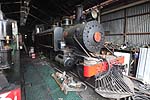
2-6-4T Wf393 (Price 5/1904) was presented to Ferrymead by the NZR in 1968 and awaits restoration. 41 of these
locomotives were built for the NZR from 1904 and the last was in service until 1969. As you can see the shed at Ferrymead is cramped! |
 |
2-6-4T Wd357 (Baldwin 19261/1901) was one of 18 of these locomotives which ran in NZR service from 1901 to 1936. This one was sold to the Timaru Harbour Board in the 1930's and they donated it to Ferrymead in 1966. It's been a consistent performer there over the years and currently awaits its 10-year overhaul. Baldwin supplied many
locomotives to NZ in the late 19th and early 20th centuries and the more modern NZ
locomotive designs probably owe as much to the Baldwin influence as to British practice. Sadly this
locomotive is the sole surviving Baldwin anywhere in NZ. |
 |
2-6-2T W192 (NZR Addington 1/1889), the first locomotive to be designed and built by the
NZR. It was preserved by the NZR after being withdrawn and is now on loan to
Ferrymead. It was withdrawn to wait overhaul in September 2014 and now occupies just about the darkest corner of the shed! Behind it is 2-6-2 C864
(NZR Hillside 272/1931). 24 of these
locomotives, intended mainly for shunting, were built from 1930. W192 was a regular performer at Ferrymead from 1972 to 1984 and is one of two survivors of the class. |
 |
2-4-0 D140 (Scott Brothers, Christchurch 36/1887) under overhaul at Ferrymead's shops. These tiny 2-4-0T's were designed by Neilson & Co and 33 were built from 1874, plus one further one which never ran for the
NZR. D140 was sold into industrial service in 1920 and arrived at Ferrymead in 1968. |
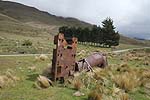 |
The only non-3ft 6in gauge locomotive I saw on this trip, not that there's that much left of it to see! This is, or was, 700mm gauge 0-4-0WT Krauss Munich 3554/1897 from the Mount Torlesse Coal Co at Avoca. The remains are dumped next to Avoca station on the Arthur's Pass railway, the main route across the island through the Southern Alps between Christchurch and
Greymouth. |
 |
We'd found a good hillside position from which to take a panoramic view of the SI train on the Arthur's Pass line and it run to time it should have produced a good sunny photo. Alas, it was running more than 2 hours late and by then heavy rain had set in and our spot had become useless. We relocated to this position beside the line a little north of Craigieburn station. By the time the train came into view the rain was coming horizontally from directly behind it. I positioned the car in order to take this view from the shelter of the tailgate but by the time the train had passed the rain had got everywhere! A shame as the scenery in the mountains is spectacular. |
 |
|
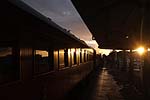
The train only caught up with the sunshine a few minutes before sunset as it ran into
Greymouth. |
 |
The last day of my trip. Here's the Pacific just after sunrise in the
locomotive yard at Greymouth. |
 |
This is the locomotive shed at Shantytown Heritage Park, a few kms south of
Greymouth. Like many of the buildings in the park it's a building rescued from elsewhere, in this case the old shed at Blackball coal mine near
Ngahere, northeast of Greymouth. The park operates a tourist railway about 1.5kms long on the route of an old bush tramway and currently has these two
locomotives in working order. We were lucky to find both in steam. The train was being worked by NZR L class 2-4-0T no 208
(Avonside 1206/1877), wearing somewhat tired paintwork - not one you could say is too shiny for its own good!! Its boiler certificate is about to expire. |
 |
The other locomotive "Kaitangata" (Sharp Stewart 4270/1897) was a development of the NZR F class 0-6-0ST design with side tanks and outside Walschaerts gear. Similar
locomotives were built for the NZR around the same time and were later rebuilt as 0-6-2T's but this one spent its entire working life at the Kaitangata Railway and Coal Co on their line in the far south of South Island. It has just undergone a general overhaul and was under test. Its new boiler certificate was issued the day before our visit. |
 |
Ten of these L class 2-4-0T's were built in 1877. They were much bigger than the little D class 2-4-0T's. Seven of them were later rebuilt at 4-4-0T's and later still as 4-4-2T's. The other three were transferred to the government's Public Works Department and renumbered into their numbering series as no's 507-9, this one becoming no. 508 and it's in this condition that it's preserved today. All three
locomotives ended up with the Wilson's Portland Cement Co on their short line up in the north of North Island and all three are now preserved in working order. |
 |
Shantytown has three other locomotives. 0-4-0T "Opossum" (Mills 3/1875) was one of three
locomotives built for the NZR by E.W. Mills's Lion Foundry in Welliington and were initially used in the building of the Foxton to Palmerston North line in the North Island. They were the only NZR
locomotives not officially allocated a class designation though they were often referred to as being A class members as their power and weight were similar. They were the first
locomotives to be built in NZ and also the first in the country to carry outside Stephenson's valve gear. "Opossum" moved to the South Island in 1877 and worked on bush tramways and construction lines for the next 80 years, ending up at Ogilvie & Son's sawmill at Gladstone, just over the hill from Shantytown. In 1958 it was put on display in a Greymouth park and moved to Shantytown in 1986. It was stored until 2009 when restoration commenced for it to be placed on static display; this was completed in 2012. |
 |
This 2-truck Climax (1203/1913) was one of seven Climax locomotives to run on NZ's bush tramways. It was built for the Potate Timber Co's line at Matapuna near Taumarunui on the North Island and assembled in the NZR's Petone workshops. It was sold a few years later to Pukaweka Sawmills Limited at Mananui and also worked Ellis &
Burnand, owners of several sawmills in central North Island. During the 1940's it moved to their Mangapahei mill, and later moved again to their mill at
Ongarue. It finished work as a yard shunter in 1962, moved to Shantytown in 1969 and worked there from 1980 until 2002. |
 |
There were also seven Heislers on NZ's bush tramways. This 2-truck locomotive
(Heisler 1494/1924) went new to the Midland Saw Milling at Camerons and was sold to the New Forest Sawmills at Ngahere in 1929. It ceased work in 1958 by which
time it had become the last Heisler product still running in NZ. It moved to Shantytown in 1969 and was stored until 2010 when its static restoration
began. It's been on display with "Opossum" and the Climax since 2012. |
 |
G & D Davidson of Hokitika built twenty six bush locomotives between 1907 and 1920 and this was the twenty fifth of them, completed in 1920. They were low-cost machines whose distinctive feature was the final chain drive which can be clearly seen in this photo. The chains were unreliable in service but as low-cost machines Davidsons earned their place amongst NZ's bush tramways. This
locomotive went new to Stratford & Blair at Paroa, not far from Shantytown, and moved in 1937 to Donaldson's at Red Jacks, near
Ngahere. It worked there for only three years but was then left for many years in their yard near Ngahere station on the Greymouth to Reefton line. It's still at the same spot, now beside route 7, the main road between Greymouth and Christchurch via the Lewis Pass and was restored about 25 years ago. |
 |
R class 0-6-4T no R28 (Avonside 1217/1878) used to be the world's only surviving Single Fairlie until the arrival of "Taliesin" on the FR in 1999! This one demonstrated an unexpected benefit of the Fairlie concept when it overran the train ferry berth at Lyttelton in 1907. The power bogie fell off into the water, causing the centre of gravity of the rest of the
locomotive to shift towards the rear and it came to rest with just its front dangling over the quayside, quite possibly saving the lives of its crew in the process. R28 ended up working for a coal mine near Reefton and it's now preserved at a park in the town. If you look at the chain link fencing which surrounds the
locomotive you'll understand the unusual viewpoint! |
 |
Everyone knows that Wales is the spiritual home of the Fairlie and it's good to see that this is appreciated in
Reefton! |
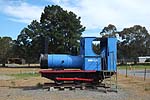 |
I got back to Christchurch for my flight home more quickly that I had expected and called in at the Maclean's Island Steam Museum, close to the airport's perimeter fence, on the offchance that someone might be there to let me in. It's another place whose railway activities are mainly devoted to preserving and operating stock from NZ's bush tramways though its most impressive display must be a huge modern hall containing numerous stationary engines. Happily the lady looking after the site was the wife of the museum society's chairman and he called in on his way home from work to show me around - really kind considering that this was an impromptu visit. This is an 0-4-0TG built by J. Johnson & Sons of
Invercargill, their A-type geared 4-wheeler built in 1903. These had a two-cylinder steam engine fitted under the smokebox which drove a crankshaft near the middle of the
locomotive which in turn drove through herringbone gears onto the central jackshaft coupled to the wheels. The tooth ration of 13.30 gave a substantial power increase. This one worked for the Lake Brunner Sawmilling Co at Ruru until 1940 and had a second life working for Jack Brothers at Bell Hill from 1947 to 1951. Eight of these
locomotives were built and two are preserved. |
 |
This 2-truck Heisler-type locomotive is Price 148/1943. Ogilvies at Gladstone wanted another Heisler but by then the Heisler factory in the US was no longer manufacturing them. Price produced what was essentially a copy as their V class of which this was the only example. It moved to Maclean's Island in 1960 and is in working order. |
 |
In the foreground is PWD 0-4-0T no 548 (Fowler 16246/1924) The Price
locomotive is in the background. |
|
|


